Health Insurance for Self Employed: Cost & Best Options

09-09-2026

Health insurance for self employed workers gives independent business owners access to doctor visits, prescriptions, and emergency coverage without needing a company plan. Freelancers, sole proprietors, and contractors pick up these plans through state exchanges, private brokers, or trade groups.
Leaving a salaried job to build your own business changes how you handle healthcare. You do not have an HR team picking options or paying most of your monthly bill anymore. You have to figure out premiums, deductibles, and out-of-pocket limits yourself, so picking the right setup keeps your personal finances intact.
Sorting out health insurance for self employed comes down to balancing monthly premiums against medical needs. You can choose EPOs, HMOs, or PPOs depending on how often you see doctors. Plus, utilizing comprehensive affordable care act health insurance options along with Schedule 1 tax deductions keeps your overall costs down while protecting your business revenue.
Marketplace Coverage Options and Plan Structures
Understanding ACA plan tiers helps you manage healthcare costs when buying self employment health insurance. Marketplace plans split into Bronze, Silver, Gold, and Platinum tiers. Bronze plans feature the lowest monthly payments with high deductibles, making them great if you rarely get sick. Silver plans cost a bit more monthly but unlock extra subsidies that trim copays and deductibles if your earnings qualify.
Plan types also dictate which doctors you can visit. A lot of freelancers wonder what is an ego health insurance plan compared to a typical PPO or HMO. EPOs require you to stay in-network for care, but you can see specialists without waiting for a primary doctor’s referral. On the flip side, options like cpo health insurance blend network access with predictable monthly rates, while an indemnity plan offers maximum provider flexibility.
If you are under 30 or facing financial hardship, health insurance for catastrophic medical events gives you a cheap safety net. These plans charge very low premiums and carry high deductibles, keeping major unexpected medical bills from wiping out your business account. Additionally, independent contractors often pair core coverage with hospital indemnity insurance or specialized critical illness health insurance to cover unexpected out-of-pocket cash needs.

Understanding Premium Costs, Subsidies, and Tax Deductions
Self-employed business owners often ask why is health insurance so expensive when buying individual coverage. Unlike corporate jobs where employers cover 70% or 80% of the bill, independent workers pay the whole tab. Individual plan pricing also reflects local doctor costs, rx prices, and general medical inflation.
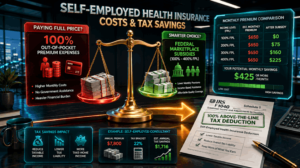
Luckily, federal tax credits make self employment health insurance way more affordable. Selecting affordable family health insurance through ACA subsidies chops down monthly costs if your income lands between 100% and 400% of the federal poverty line a figure you can easily project using an ACA subsidy calculator. Even better, you can deduct 100% of your insurance premiums on Schedule 1 of Form 1040, lowering your income tax bill even without itemizing deductions.
If you just left a job, you might ask how to get health insurance without a job while building your client roster. Losing corporate coverage triggers a 60-day Special Enrollment Period (SEP) so you can sign up for marketplace plans right away during ACA health insurance 2026 enrollment windows. If you take on side gigs, part-time employee health insurance options can keep you covered during the shift.
Managing Transitions, Job Changes, and Carrier Selection
Going full-time freelance means knowing how to switch insurance without gaps or penalties. People stepping away from regular jobs ask can you cancel health insurance at any time. Private and ACA plans allow cancellation whenever you want, so you can jump to a spouse’s policy or a group plan as soon as your setup changes.
Checking local health laws prevents surprise fines during tax season. A common question is whether it is illegal to not have health insurance. While federal tax penalties for skipping health coverage dropped to zero, states like California, Massachusetts, New Jersey, Rhode Island, and DC still charge local tax penalties if you go without coverage.
Checking out the best health insurance plans USA options helps you secure solid doctor networks and decent customer service through advisors at RGP Agency. Major national carriers like Blue Cross Blue Shield, UnitedHealthcare, Kaiser Permanente, and Aetna offer reliable individual plans. Many self-employed professionals also bundle core medical with health insurance with dental and vision—often reviewing delta dental and vision insurance or checking if providers accept costco vision insurance to keep preventive care affordable. If you travel overseas for work, adding expat health insurance keeps you covered across borders.
If you combine freelance work with seasonal gigs, options like health insurance for unemployed status, state Medicaid, or short-term comp health insurance plans can plug coverage gaps while your income fluctuates. Additionally, entrepreneurs who want complete financial and personal protection often pair health coverage with no medical exam life insurance to secure their family’s baseline stability without lengthy underwriting delays.

Real-World Application: Sole Proprietor Health Planning
Look at a freelance software developer in Texas who left a company job to build an independent consultancy. The developer needed solid coverage that handled shifting monthly revenue and covered overseas business trips.
Using a Special Enrollment Period after leaving corporate work, the developer selected a Silver ACA EPO plan. That choice unlocked monthly subsidies, covered routine doctor visits, and provided specialist care without needing referrals.
To handle international trips, the developer added an expat health insurance add-on. Come tax time, the developer deducted 100% of the health insurance premiums as an above-the-line business expense, knocking down federal taxes while keeping solid medical coverage through comprehensive life and health insurance strategies.
Frequently Asked Questions
How do I qualify for the self-employed health insurance tax deduction?
You qualify if your business made a net profit on Schedule C or F, you paid premiums out of pocket, and you could not join an employer plan through your spouse.
What is the main difference between an EPO and a PPO plan?
An EPO forces you to use in-network doctors for non-emergency care, while a PPO lets you visit out-of-network providers if you pay extra out-of-pocket.
Can I buy self-employed health insurance outside open enrollment?
Yes. Qualifying life events like losing a job, getting married, having a baby, or moving open a 60-day Special Enrollment Period to grab coverage.
Can I deduct health insurance premiums if my business loses money?
No. Your self-employed health insurance deduction cannot exceed the actual net profit your business earned that tax year.
What happens to my premium tax credits if my freelance income changes?
You update your earnings on the Health Insurance Marketplace portal. Updating your income adjusts your monthly subsidy so you avoid a surprise tax bill at year-end.
Editorial Review & About the Authors
Written & Reviewed By: Pablo Pérez
This article was authored and technically reviewed by Pablo Pérez, senior financial advisor and co-founder of RGP Agency. Led by the husband-and-wife team of Pablo and Genesis Pérez, RGP Agency is a family-devoted, community-centric financial planning organization. Based in Texas, the Pérez family and their team of advocates specialize in crafting wealth preservation, healthcare planning, and legacy protection strategies tailored to individual family dreams and business realities. To learn more about our mission, core values, and licensing, visit our official About Us page.
Corporate Headquarters & Contact Verification
For policy designs, personalized health plan strategies, or to verify agent credentials, you can contact our registered Texas office directly:
- Office Address: 8376 Davis Blvd, Suite 246, North Richland Hills, TX 76182
- Direct Phone: (817) 973-5255
- Official Website: rgpagency.com
References & Authority Citations
- RGP Agency Editorial Team. (2026). Health Insurance Options for Self-Employed Individuals and Small Businesses. RGP Agency Health Insurance Series. https://rgpagency.com/health-insurance/
- Centers for Medicare & Medicaid Services (CMS). (2026). Overview of Health Insurance Marketplaces and Qualified Health Plans. U.S. Department of Health and Human Services. https://www.cms.gov/marketplace/about/overview-exchanges
- Internal Revenue Service (IRS). (2026). Deduction for Health Insurance Costs of Self-Employed Individuals (26 CFR § 1.162(l)-1). Legal Information Institute / Department of the Treasury. https://www.law.cornell.edu/cfr/text/26/1.162(l)-1
- Internal Revenue Service (IRS). (2026). Schedule 1 (Form 1040): Additional Income and Adjustments to Income Overview. Department of the Treasury. https://www.irs.gov/forms-instructions
- KFF (Kaiser Family Foundation). (2026). Health Insurance Marketplace Subsidy Calculator and Coverage Guidelines. KFF Policy Research. https://www.kff.org/interactive/subsidy-calculator/
Social Share

Life Insurance
Protect your family’s future.


Health Insurance
Stay healthy, stay protected.

Income Annuities
Turn savings into steady income.

