How Much Is Affordable Care Act Michigan? (2026 Costs)

04-08-2026

The full price cost of a silver plan affordable care act michigan, which you would have to pay with no federal assistance, generally costs $460 to $580 a month. The good news? The Advanced Premium Tax Credits reduce that bill to below $100 for most state residents. Ultimately, your income versus the Federal Poverty Level, age, residency in Michigan, plan selection, and tobacco use end up determining what you pay for an affordable care act michigan policy.
There are so many health plan options that it becomes tough to decide during the sorting process. Prices fluctuate in all 83 counties, largely depending on state laws and federal subsidies as well as which insurance brands are battling for local customers. Knowing these base numbers helps you avoid the pain of overpaying if you’re purchasing affordable family health insurance privately for yourself, or just left a job with guidance from RGP Agency.
The state of Michigan runs its marketplace directly through HealthCare.gov, connecting local purchasers with national and regional insurance providers. A plan in Wayne County is a far cry from something you can get way up in the Upper Peninsula, both in terms of cost and availability. Evaluating options under the affordable care act michigan and using an ACA subsidy calculator helps you understand your actual annual health budget, which is your baseline premium minus whatever you get as tax credits.
Michigan ACA Pricing and Metal Tiers in 2026
The marketplace in affordable care act michigan organizes its plans based on metal tires: Bronze, Silver, Gold, and Platinum. Bronze options have the lowest monthly premiums, but you pay through the nose when you see a doctor: they cover just over 60 percent of average health care bills.
Silver plans cover about 70 percent and form the basis for determining government assistance. If your income qualifies, Silver plans also offer additional savings that provide even lower out-of-pocket costs, called Cost-Sharing Reductions. Gold and Platinum plans have higher monthly fees upfront, but your deductible will be much lower, which is useful if you see doctors frequently under an affordable care act michigan plan.
These rates are regulated by the Michigan Department of Insurance and Financial Services within strict community rating rules. Insurance companies cannot penalize you for pre-existing conditions, gender, or medical history. Premiums are based solely on age bands, your county’s rating area, family size, and tobacco use. Young adults in urban centers receive the lowest initial rates, while older individuals living in sparsely populated rural counties see far higher base rates prior to adjustments.

- Bronze Plans: Low monthly charges, but individual deductibles regularly hit $7,000.
- Silver Plans: Balanced monthly fees and cost-sharing savings, serving as the benchmark for federal subsidies.
- Gold Plans: Higher upfront monthly bills instead of big deductibles during the year perfect for those who need regular doctor visits.
- Catastrophic Plans: Available for adults under 30 or those qualifying for hardship waivers, acting as emergency safety net coverage.
Federal Subsidies and Income Limits in Michigan
Available for adults under 30 or those qualifying for hardship waivers, acting as emergency safety net coverage. Federal tax credits do the bulk of the work to make coverage affordable care act michigan lower the amount you pay monthly for ACA health insurance 2026, based on your income relative to the Federal Poverty Level (FPL). You are eligible for sliding-scale savings if your income is between 100% and 400% of the FPL, capping the cost of your benchmark plan to a set portion of your family earnings.
Silver plans also come with additional savings called Cost-Sharing Reductions (CSR). When opting for a silver tier, Michiganders making up to 250% of the FPL automatically receive smaller deductibles, lower copays, and capped out-of-pocket limits. In effect, this upgrades an affordable care act michigan silver plan close to the benefits of gold or platinum tiers while keeping the monthly premium unchanged. Make sure your income estimate is accurate during sign-up, or the IRS will reconcile the difference at tax time.
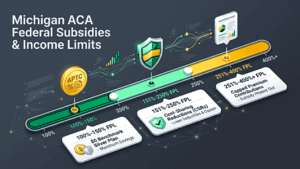
- 100% to 150% FPL: Gets you within spitting distance of a $0 or near-$0 Silver plan every month.
- 151% to 250% FPL: Unlocks gold-standard Cost-Sharing Reductions, drastically lowering annual deductibles.
- Subsidy Caps: Protect consumers by capping premium contributions, preventing budget disruption if local insurance rates spike.
- Self-Employed Deduction: Self-employed Michiganders can deduct ACA health insurance premiums to reduce taxable income.
Carrier Choices and Regional Costs
The affordable care act michigan market remains competitive with regional non-profits, commercial brands, and hospital-backed plans. Blue Cross Blue Shield of Michigan and Blue Care Network hold the widest coverage across both peninsulas. Other key payers include Priority Health, Health Alliance Plan (HAP), McLaren Health Plan, Meridian, and Oscar Insurance. Comparing local carriers against the best health insurance plans USA standards while having three or four competing brands in a county helps drive down baseline prices.
Your rating area assignment monitors localized care costs and hospital competition. Rating Area 1 (Metro Detroit and Southeast Michigan) shows completely different pricing behavior than rural northern counties. Regions dominated by a single major hospital system usually have higher baseline prices before subsidies apply under the affordable care act michigan.
- Metro Detroit & Grand Rapids: Higher carrier competition keeps baseline plan prices lower for consumers.
- Northern Michigan & Upper Peninsula: Rely on wider regional networks, raising overall baseline costs.
- HMO Plans: Hold down monthly premiums by requiring primary doctor referrals within a specified network.
- PPO & EPO Options: Allow you to forgo specialist referrals, though with a slightly increased monthly payment.
Enrollment Windows and Qualifying Life Events
Open Enrollment runs every year from November 1 through January 15 across Michigan. Choose a plan by December 15 for coverage starting January 1. Sign up between December 16 and January 15, and coverage begins February 1. Missing this deadline locks you out of enrolling in an affordable care act michigan policy for the remainder of the calendar year unless a qualifying life event triggers a Special Enrollment Period (SEP).
A Special Enrollment Period gives you up to 60 days to pick a new plan following a major life shift. Qualifying events include losing job-based health insurance, losing Healthy Michigan Plan (Medicaid) coverage, getting married, having a baby, or moving to a new county. This protects you so unexpected emergency room charges don’t wipe out your savings.
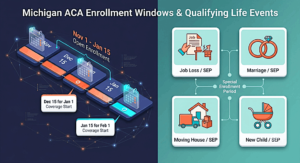
- Annual Open Enrollment: Standard sign-up window runs yearly from November 1 to January 15.
- Effective Coverage Dates: Enroll by Dec 15 for Jan 1 start; enroll by Jan 15 for Feb 1 start.
- Special Enrollment Triggers: Job loss, marriage, relocation, or birth of a child unlock a 60-day window.
- Medicaid Transitions: Ending Healthy Michigan Plan coverage allows for a seamless transition to a marketplace plan.
Practical Example: Real-World Michigan ACA Costs
Here is how the math actually works out in practice for someone shopping for affordable care act michigan coverage. Consider a 42-year-old freelance consultant living in Kent County (Grand Rapids area) with $38,000 in yearly income. Without subsidies, a standard Silver benchmark plan in that region costs approximately $480 a month. Since $38,000 is right around 250% of the Federal Poverty Level, government subsidy rules limit their share of the benchmark plan to about 6% of gross income.
After applying the Advanced Premium Tax Credit, their net cost drops to roughly $190 per month. Additionally, with their income eligible for Cost-Sharing Reductions, the annual deductible on their Silver plan drops from $5,500 down to just $2,000. If they chose a Bronze plan instead, that same tax credit would bring the monthly payment down to $0–$15 per month, though with a higher deductible for non-preventive care.
Frequently Asked Questions (People Also Ask)
How much does ACA health insurance cost in Michigan on average?
In Michigan, a silver level benchmark ACA plan costs about $460 to $580 per month without subsidies. However, the majority of residents qualify for income-related tax credits that lower their actual contribution to less than $100 a month.
How do I sign up for ACA health insurance in Michigan?
Apply directly online through HealthCare.gov during Open Enrollment or a Special Enrollment Period. You must provide proof of identity, project your income for the coming year, and describe any employer coverage options available to you.
What are the income limits for Michigan ACA subsidies?
Financial assistance starts at 100% of the Federal Poverty Level (around $15,060 for an individual). Under current federal rules, there is no hard upper income cap; subsidies scale so premium costs never exceed a set percentage of your total income.
Does Michigan operate its own state health insurance marketplace?
No, Michigan uses the federal HealthCare.gov platform for enrollments and subsidy calculations. However, the Michigan Department of Insurance and Financial Services regulates consumer rules, plan approvals, and insurance rates locally.
What happens if I miss the Michigan ACA enrollment deadline?
If you miss the January 15 deadline, you cannot buy a marketplace plan for that year unless you experience a qualifying life event such as losing job coverage, getting married, or moving which triggers a 60-day Special Enrollment Period.
Editorial Review & About the Authors
Written & Reviewed By: Pablo Pérez
This article was authored and technically reviewed by Pablo Pérez, senior financial advisor and co-founder of RGP Agency. Led by the husband-and-wife team of Pablo and Genesis Pérez, RGP Agency is a family-devoted, community-centric financial planning organization. Based in Texas, the Pérez family and their team of advocates specialize in crafting wealth preservation, comprehensive life and health insurance solutions, and localized policy designs. To learn more about our mission, core values, and licensing, visit our official About Us Page.
Corporate Headquarters & Contact Verification
For personalized health insurance guidance, ACA subsidy evaluations, or to verify agent credentials, you can contact our registered office directly: https://rgpagency.com/health-insurance/affordable-care-act/
- Office Address: 8376 Davis Blvd, Suite 246, North Richland Hills, TX 76182
- Direct Phone: (817) 973-5255
- Official Website: rgpagency.com
References & Authority Citations
- Centers for Medicare & Medicaid Services (CMS). (2026). Health Insurance Marketplace Quality Initiatives & Regulations. U.S. Department of Health and Human Services. https://www.cms.gov/marketplace
- HealthCare.gov. (2026). Michigan Marketplace Health Plans, Rates & Subsidy Calculator. Federal Health Insurance Platform. https://www.healthcare.gov
- Michigan Department of Insurance and Financial Services (DIFS). (2026). Consumer Guide to Health Insurance & Rates in Michigan. State of Michigan Official Portal. https://www.michigan.gov/difs
- Internal Revenue Service (IRS). (2025). Publication 974: Premium Tax Credit (PTC) & APTC Rules. Internal Revenue Service. https://www.irs.gov/pub/irs-pdf/p974.pdf
- Kaiser Family Foundation (KFF). (2026). Health Insurance Marketplace Subsidy Calculator & State Benchmarks. KFF Health Research. https://www.kff.org/interactive/subsidy-calculator/
Social Share

Life Insurance
Protect your family’s future.


Health Insurance
Stay healthy, stay protected.

Income Annuities
Turn savings into steady income.

